

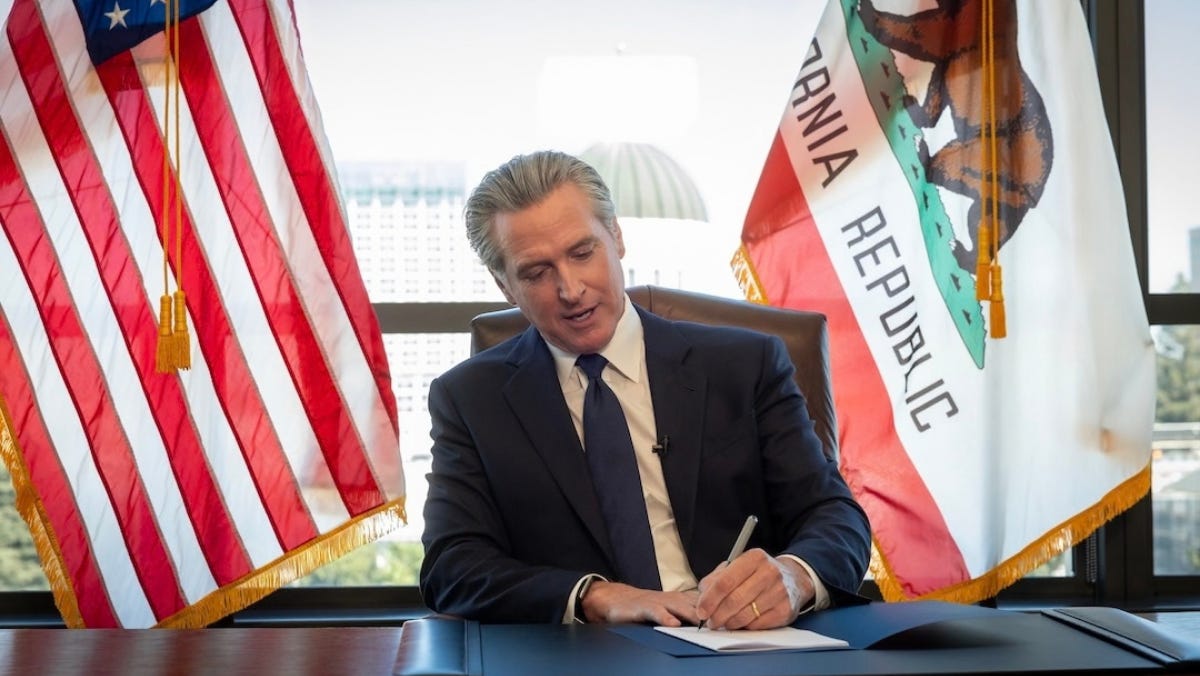
Earlier today, California Gov. Gavin Newsom signed the Community NEWS Act, a program projected to direct more than $200 million in refundable local journalist employment tax credits over the next five years.1 It’s the biggest-ever state investment in local news of its kind. Newsom told reporters he hoped all the other U.S. states adopted policies like it.
A nice dream. It got me thinking.
If there’s anything I’ve learned in life (and politics) about winning by this point, it’s that winning is work. And luck. And that winning over time is just work and luck layered on top of each other, work upon luck, luck upon work, over and over and over, until the era before that first lucky win gets fully shoveled over, concealed, and finally forgotten in a fossil layer packed beneath a highway overpass. By that point there’s no work or luck left to look at. Just infrastructure. Scenery.
The California local news community and its champions were far from being certain about being able to enjoy the fruits of their labor. In recent months, they had put in all the work to win, with more than 150 organizations endorsing, coordinating, writing emails, texts, editorials. But what I’ve learned about governors is that sometimes you can’t know. Organized collective forces can be predictable. Individual people are not. With the individual, in the end, you just hope.
But the work and the luck paid off, and after a couple other past breaks, something resembling a landscape is emerging. California now has a five-year local journalist employment subsidy that makes it cheaper to hire and employ journalists. There’s a large publicly funded local fellowship and editorial training program being run out of UC Berkeley that places early career journalists in local newsrooms. There’s a Civic Media Program that matches public-private dollars to distribute grants partially based on need, and additional support for ethnic media.
The features had all been built separately in recent years, but if you squint, you can start to imagine how all the scattered spadework could connect into an increasingly coherent industrial policy landscape where little existed five years earlier. A fellowship program that spots early career journalists to local newsrooms to upskill for a couple years; a journalist employment tax credit that smoothly converts those fellowships into permanent staff jobs, which are supported on a sectoral level; and a public-private partnership engine that drives new philanthropic revenue and delivers support where support is most badly needed.
A connected local news policy, if it’s an outcome that people would want — and I’m sure somewhere loose thoughts are already congealing — wouldn’t have been the product of a centralized vision or a five-year plan, a foreordained destination on a carefully drawn roadmap. It would have instead been the organic, iterative outgrowth of a lot of people with different interests and outlooks working hard, being lucky, working hard, being lucky, workluckworkluckworkluck then suddenly huh, there’s a connected stretch of pavement taking you somewhere interesting.
The great development economist Albert O. Hirschman was obsessed with the incremental developments like these that lead unevenly to transformations, with the “frequently fragmentary character of political-institutional change” that “may well result from the combined efforts of many parties rather than the from the exertions of a single group.”
You could wait until you’re dead for the big revolution that sweeps away the ancient regime to unleash the new society. Instead, “most of the time, historical reality is, of course, far less neat: sociopolitical change entrained by the contradictions is often partial, grudging, and with a lot of unfinished business left behind, so that the need for further change makes itself felt once again in fairly short order,” Hirschman wrote.
There’s a troubled situation of diminishing returns; we create a fix; the fix is not fully adequate; we make another fix. Even today, Governor Newsom was criticizing the journalist employment credit bill as he was signing it and urging the next Legislature and next Governor to keep looking at the policy. This is a quintessential Hirschian figure, “the observer and policy maker [who] will think in terms of sequences in the course of which a forward step in one direction will induce others.”
The important thing is that the seed is planted, even if it fell out of a pocket. Little ideas can grow in cracks where bigger ideas struggle to take root, then expand the cracks. The stone breaks; at some point, the gardeners can really plant. “Voluntaristic change will often take over after unintended change has done the spadework and created conditions in which the outline of previously hidden possibilities of change can begin to be perceived by an activist change agent,” concluded Hirschman, who defended “the right to a nonprojected future as one of the truly inalienable rights of every person and nation.”
I wouldn’t dare advocate against policy planning. This would be like advocating against work, which is necessary for success. It’s just hard to plan for luck whenever luck is making the plans.
The views here are my solely my own; little ideas that got tall.
A nice write-up, Matt! Thank you for sharing.
Congratulations to you and the whole RLN team on this amazing accomplishment! Let's hope it is, in fact, the first of many states to support local news in this way.