
Exit Hollywood
Oscars in a time of trouble in L.A.

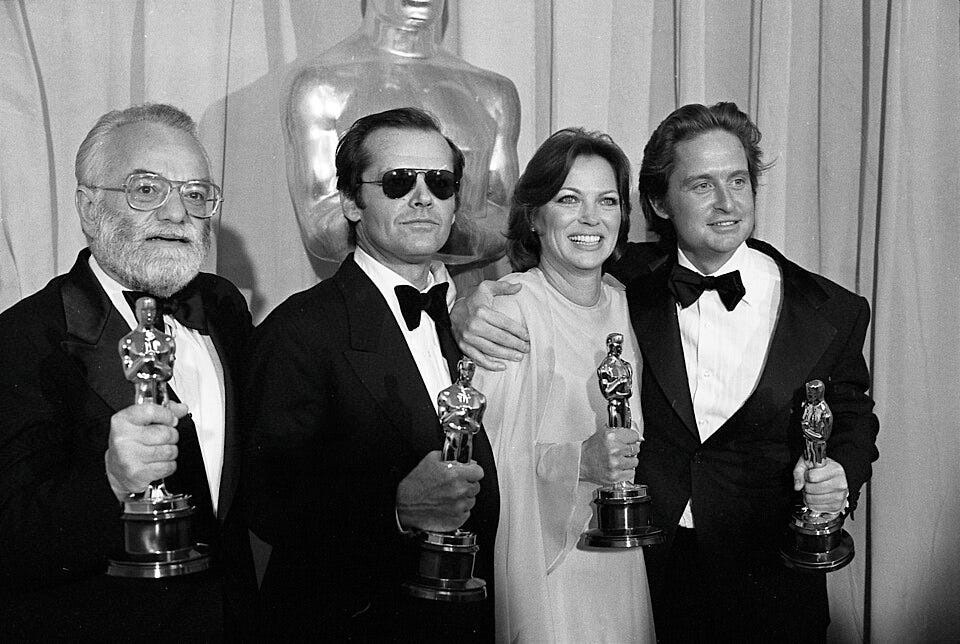

The above-average levels of paranoia in Hollywood these days are causing psychic disturbances across Los Angeles, the P-waves radiating through the dense networks of actors, writers, producers, agents, gaffers, hair and makeup people, costumers, crafts table providers, IP lawyers, tax credit miners, accountants and incorporators, talent coaches, assistants, FYC ad people, trades journalists and the off-duty cops moonlighting as set security, who all have their endangered place in the rigamarole.
In Thomas Pynchon’s “The Crying of Lot 49,” pervasive dread and dislocation are indistinguishable from the California lifestyle:
In the early ‘60s a Yoyodyne executive living near L.A. and located someplace in the corporate root-system above supervisor but below vice-president, found himself, at 39, automated out of a job. Having been since age 7 rigidly instructed in an eschatology that pointed nowhere but to a presidency and death, trained to do absolutely nothing but sign his name to specialized memoranda he could not begin to understand and to take blame for the running-amok of specialized programs that failed for specialized reasons he had to have explained to him, the executive’s first thoughts were naturally of suicide.
Conspiracy thinking offers a way out, by suggesting there exists “a secret richness and concealed density of dream … a real alternative to the exitlessness, to the absence of surprise to life, that harrows the head of everybody American you know, and you too, sweetie.” It’s unclear if the conspiracies are actually true. But you can live as if they are.
Well, choose your enemy. If it’s not the AI that’s getting you, maybe it’s the runaway production to lower labor cost jurisdictions, or the audience drifting away to microdramas on YouTube, or the former SAG-AFTRA member and current U.S. President Donald John Trump (“The Apprentice,” “Home Alone 2: Lost in New York”) putting his thumb on the antitrust enforcement scales to support a buddy’s ill-advised takeover of Warner Brothers.
The fact that there’s even this much psychologizing makes Hollywood distinct from Silicon Valley or Detroit: Even in an age of automation, there are limits to how many humans you can drum out of the production process and still have a viable product. Like some kind of air bubble trapped in an underwater shipwreck, Hollywood is one of those ultraweird American exceptions to the rule, like newsrooms and publishing houses, where the business realities of mass production still cohabitate with the occult predilections of craftspeople. Complex divisions of labor, built upon the febrile intelligences and starving egos of skilled weirdos? Whole corporations do this? The talent keeps trying to do big projects in VistaVision. Does David Ellison know he’s counting on artists help pay back the $79 billion in debt for the new Paramount-Warner Brothers goliath? Netflix, a real company, knew better, and will soon benefit from the army of cheap and desperate talent Ellison cuts loose in pursuit of synergies.
It’s one of those dark times that remind you that the Academy of Motion Picture Arts and Sciences was originally founded as a union-busting exercise by Louis B. Mayer, who was trying to keep the talent under-control enough so that the businesspeople could make some real money. A real-life corporate conspiracy! It didn’t quite work, but the awards stuck around, as if to remind everybody how un-automatable the enterprise still is. The humans get up onstage and start thanking everybody, but most typically, in statistical descending order, 1. Their family, 2. God, 3. their agent, and 4. Steven Spielberg. With the whole world watching, it takes the peer pressure of an entire orchestra to get them offstage. Violins and all.